Saturday, 16 November 2013

Yi Peng

I didn't change or shower upon return to the hostel. Which was just as well given what followed. At about 1800, the owner popped his head into the dorm and asked how come I wasn't going with the rest of the group in a songthaew to the Yi Peng site. I hadn't heard about the excursion. I had only asked the owner the day before how to get there. It seemed that he had taken the initiative and organised (hired) transport for the hostellers. So I popped on my sneakers and grabbed my daypack and we were off.


Tardiness is sometimes rewarded. I got to sit in the air-conditioned cabin with the driver, who spoke good English, while the others had the benches in the back. We took a back road to enter the campus of Maejo University, an agricultural college. The driver had to call his friend on the mobile several times to find the exact way; he confessed that it was his first time taking that route. There was a lot of traffic with the same destination so it took about an hour to get there.
The site was a canal bank. It was absolutely chockers with people. As expected of any huge gathering like this in Thailand, hawkers were out in force. Besides the lantern sellers, there were stalls selling snacks and LED trinkets.
We had until 2100 to return to the songthaew. I didn't want to get lost so asked a couple of German boys if I could stick with them, figuring them to be more reliable than the other hostellers.

The bank of the canal was crowded, grassy, uneven and slippery in parts. There was the ever present hazard of slipping into the canal and indeed later I saw a woman slip in, and get hauled out by rescuers.

Most of my shots did not come out well. The main problem was the dim light leading to long exposures and camera shake. It was a situation where an expensive kickass camera and monster lens would have been handy. Still, I've been there and that's what counts.
One of the more successful shots.
Lighting the doughnut.
And it's ready to fly.
One of the show-off lanterns with a sparkler attached.

The Germans decided that they wanted to participate so they bought a pair of lanterns each from a vendor. There was a sports field or similar open area where there would be a mass launching of lanterns.

We jostled our way along with the rest of the crowd towards the field. Progress was agonisingly slow. As we approached, we could hear the announcer say over the PA: Please wait until the signal to release the lanterns together so that we can get a beautiful photo.
This was as close as we got when the release happened. I suspect it would have been impossible to get into the field anyway; we would have had to start many minutes or hours before.
Still, it was an unforgettable sight.

Somehow one of the Germans boys got separated. The other and I decided to return to the canal bank. Eventually we were reunited but from the expression on the lost one's face, it had been a bit traumatic.

So with the remaining 30 minutes or so, we had to launch the unused lanterns and find our way back to the car park. But we did it and the Germans got the photos and videos they wanted.

We got back to the songthaew on the dot. But others were late. It didn't matter anyway, the roads were clogged, so badly that the people walking back to cars they had parked hundreds of metres away could match the songthaew's speed.


Back in Chiang Mai, the group decided to get a late dinner at the Dada Kafe, despite some reservations. After a 20 minute walk, we discovered that it was closed. Disgruntlement all around. I couldn't help thinking: Abilene Paradox. (I've been doing a psychology course.)

So we went to another restaurant. They were about to close the kitchen but agreed to take our orders. After a while they came back and said sorry we've run out of something or other, would you like to change your order? This happened a couple of times, and finally they said, sorry we really don't have any food left. So we paid for the drinks and left.

The Germans and a British guy ended up buying microwaved snacks at a 7/11. I still had the bento bowl from earlier so I went back to the hostel to eat that.

It was such a relief to strip out of sweat drenched clothes, shower and get into bed. Unfortunately that wasn't the end of the night for revellers. Loud firecracker bangs continued into the small hours of the morning. I remembered doing such things as a kid, but I dislike sudden loud noises now. It felt at odds with the very polite Thai culture. I suppose each culture has its own way of having a fling.

Waroros market

No tours today so I can relax. The Yi Peng lanterns aren't until the evening, naturally, so I had the whole day at my disposal. There were several things I wanted to buy so I was headed for the markets. One was a tool for crimping chor muang, a Thai steamed dumpling. Yui had told me which shop to get it at, and also the important detail that there is a rising inflection on muang.
Most visitors didn't use this gazebo for breakfast as it's separated from the main cluster of tables, but it is pretty.


But first a slow breakfast of müsli and mocha from the hostel bar.

For variety, I decided to try Loi Kroh Road to reach the river, instead of the popular Thanon Ratchadamnoen. This was nowhere near as grand as the map suggested. But I found a Rimping supermarket where I bought a mid-morning snack of chocolate milk, a chicken puff, and a danish pastry. I also couldn't resist buying a bento bowl, with the vague idea of having it for lunch.

I crossed the river and walked along the opposite bank where there were some restaurants with river views. Someone had told me that tables there are often booked for Loi Krathong. Thai massage shops seemed to be everywhere. You can also get fish spa treatment. I last saw those fish in Turkey.


Turning west at Thanon Charoen Muang, I crossed the river then headed north. Waroros Market was a covered building facing another market, Tonlamyai. The ground floor sold food, mostly dried produce and candied fruit. I bought a stick of durian cake, purely for research purposes mind you. The upper levels sold clothing and accessories. I didn't find the leather belt or reading glasses I wanted. 
Nearby is the flower market where Loi Krathong floats were on sale.
The displays were very colourful too. I had been told that Chiang Mai province produces a lot of cut flowers that are transported to Bangkok and other markets.
This is an old restored Chinese temple (with Chinese characters) which means that there must have been Chinese influence or Chinese migration in the past. More than that I couldn't tell you, I didn't swot up on the history of northern Thailand.


Some tortoise shaped baked goods. I suspect they are not meant to be eaten but are religious offerings, perhaps substitutes for real tortoises that are released to gain merit.


I'm pretty sure that these are not meant to be eaten. All that colouring, hmm.


At the Tha Phae gate they had set up a stage and seating. I guessed there would be performances for Yi Peng and made a note to come back later. But it was not to be; it was even better.

At the kitchen utensil shop they didn't speak Chinese as I had been told, so I had to resort to gestures to get them to fish out the chor muang tool from their stock. They communicated the price using a large calculator.

I returned to the hole in the wall place for another satisfying lunch, this time of Pad Thai. Then desert of watermelon slices before going back to the hostel to siesta.

Friday, 15 November 2013

Lanterns galore

After the class I asked to be dropped off at Kad Suan Kaew, a shopping centre just outside the northwest corner of the old city. It was not as upmarket as those in say Bangkok, or Kuala Lumpur, and was a bit forlorn in sections. Possibly due to relative income levels. The street traders just outside the complex seemed to be doing the best. The supermarket was well stocked though and even had a cafeteria. I didn't need dinner after grazing all day on my own cooking so I bought a tray of apple and guava quarters and ate half of them on the spot. A sundae at Swensens was cheap so I had one.


I walked back to the old city. It was hard to cross the roads due to traffic. Obviously foot traffic isn't encouraged and people go around in cars, motorbikes (very common), tuk tuks or songthaews.

The old city is square and surrounded by a canal, smelling of carp. There are only a handful of canal crossings between the outer and inner ring roads. I entered the old city and took a north south artery to the west of the hostel but walked too far south before turning east. But even mistakes have a silver lining and I walked past Wat Inthakin, gloriously lit up for the weekend festivals.

There are literally hundreds of wats in and around Chiang Mai. I didn't visit any of them though. Religious buildings and statues are not my thing, even if it's the Buddha.


I was next to the Three Kings Monument again and Yi Peng lanterns were being released. Here's one that's not plain white.


Across the street was a hall of lanterns and people were busily taking pictures in the multicoloured lights.


A whole spectrum of colours was presented.


Some that were not part of the hall.


A structure with a lantern show of photos, possibly of the king.

And that was the end of my nocturnal perambulations.

A Lot of Thai

This day's schedule was much more relaxed. I was taking an all day Thai cooking class with the aforenamed school. I was to be picked up at 0915 so I could have a leisurely breakfast. It was bowl of müsli: oats with fruit (apple, pineapple and banana), yoghurt and a drizzle of honey. I accompanied this with a coffee.

There was a mischievous kitten at the hostel. Here it's trying to bat my camera's lens cap.


Yui and her husband Kwan run highly recommended cooking classes at their home in Chiang Mai. The class size is limited to 8 or 9 meaning that you get personal attention. When I was signing up for the class, my mouth watered just looking at the list of Thai dishes that we would learn to make.

Here are the cooking stations ready for us students to follow Yui's instructions after watching her demonstrate at her station.


The first dish we were taught was fried rice, in this case brown rice. White rice can also be used.

I found that I need much more practice in slicing the lemongrass and the kaffir lime leaf. Thin slices of about 1 mm are required, otherwise the fibre is apparent when you eat the result. It's also a matter of economy; you want maximum extraction of the taste from the herbs. For a practiced cook, the cycle of slice and shift is effortless, but the result of a lot of practice. I had a few pieces that weren't cut through.


Here are the ingredients mise en place ready to cook. The pumpkin is a nice touch I hadn't seen before. Also notice that Thai garlic is used. This is smaller but more pungent than the more commonly seen Chinese garlic. We didn't need to remove the skin because it is thin.
And here is my result. It was yummy. Because the ingredient quantities had already been measured for us, there was little chance of us failing unless we didn't pay attention to the ingredient preparation, the amount of heat, or the cooking times.


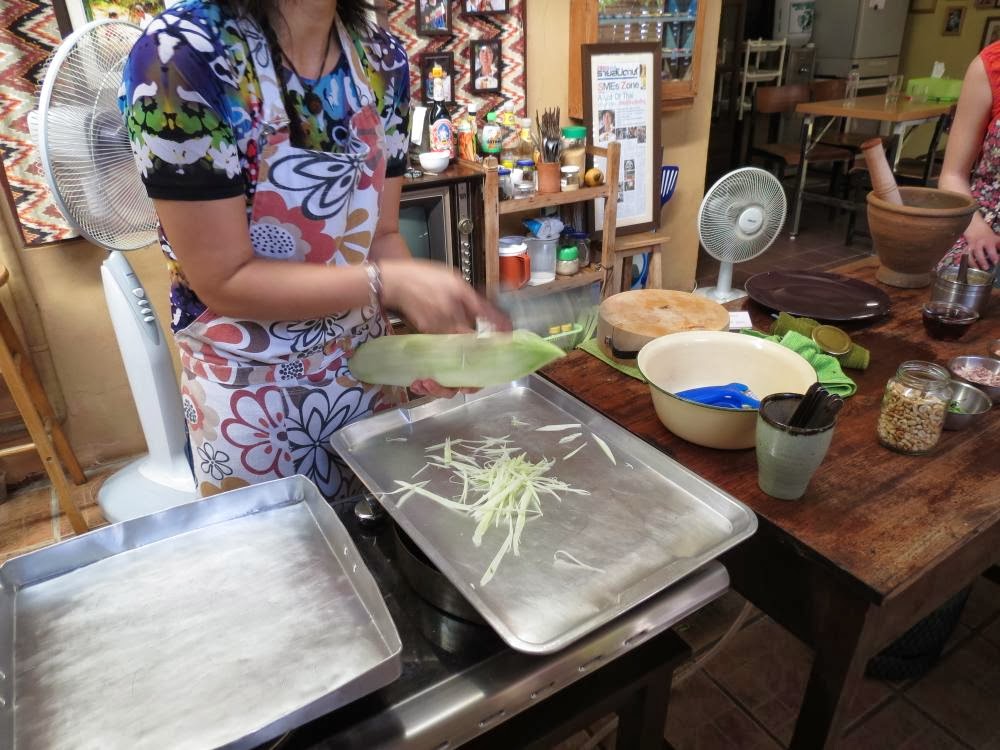
Our second dish was papaya salad. Here Yui is demonstrating slicing the green papaya. In the old days, julienning the papaya was done with nothing more than a sharp knife, first making many tightly spaced longitudinal cuts, then shaving off the strips. Nowadays you can buy a zig zag tool for this.

Substitutes for green papaya include green mango, or even granny smith apples or hard pears.


The sweet-sour-piquant dressing of lime juice with flavours is what makes this salad work. We used garlic, fish sauce, palm sugar, and chilli. In addition to the papaya, Yui's recipe also includes long beans and tomatoes. Roasted peanuts and dried shrimp add a bit of crunch.


And here is my result. Wow, I have to count those potent Thai chillis carefully. What I put in was a bit eye-watering for me and might be too much for my dinner guests.


Next up was red Panang curry with chicken. Yui explained the difference between coconut cream and coconut milk. For the first stage coconut cream is used and gently heated until it "cracks", that is, oil separates out.


Then the Panang curry paste is stirred in, followed by the meat. When the meat is almost cooked, coconut milk is added, then the palm sugar and fish sauce. The decorative herbs come last.


Then it was time for, not a lunch break, since we had been eating our own creations all the time, but a market break. Some of the group stayed behind to make curry paste from scratch, while the rest of us visited a local market. We were taken there in the signature combi van you see in the second photo.


This is not food but floats for Loi Krathong consisting of flowers on segments of banana trunk.


I recognised many types of produce from my SE Asian childhood. Here are Thai eggplants. There were too many more pictures of produce than fit here.


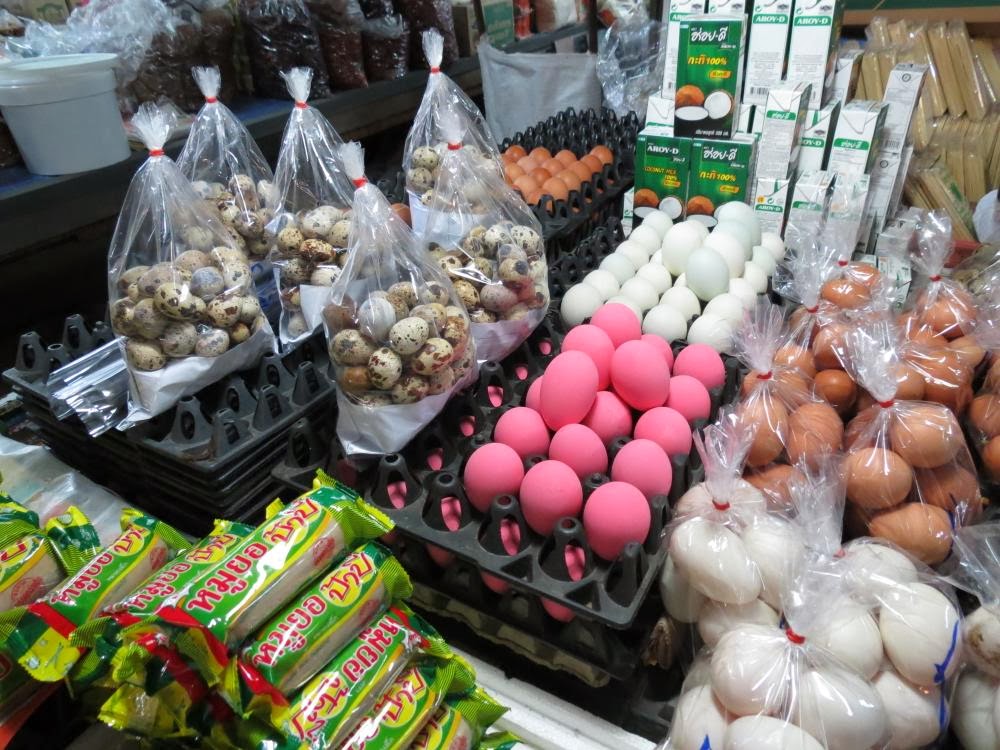
These pink eggs are just a variation on Chinese century old eggs, they have been dyed pink to differentiate them from normal eggs.

I have to admit I went a little overboard when I spotted red bean dessert and chendol dessert at the market and bought a plastic packet of each. They were a bit too sweet for my taste though. Either that or I prefer subtler sweet things now.


Back at the hot stoves, the next dish was Pad Woon Sen, stir fried glass noodles. Glass noodles are more delicate than the usual rice noodles so need less frying time. Here is are the ingredients mise en place. Also a tip, when frying the egg for rice, it's done before the rice, but for noodles it's done after the noodles.


Just before tucking into my result.


Finally the last two dishes, fried bananas and stuffed cucumber soup. The banana pieces needed to soak in the batter for a while so we prepared the stuffed cucumbers while waiting.


The stuffed cucumbers in soup. The core of the cucumber isn't wasted, it's cooked in the soup.


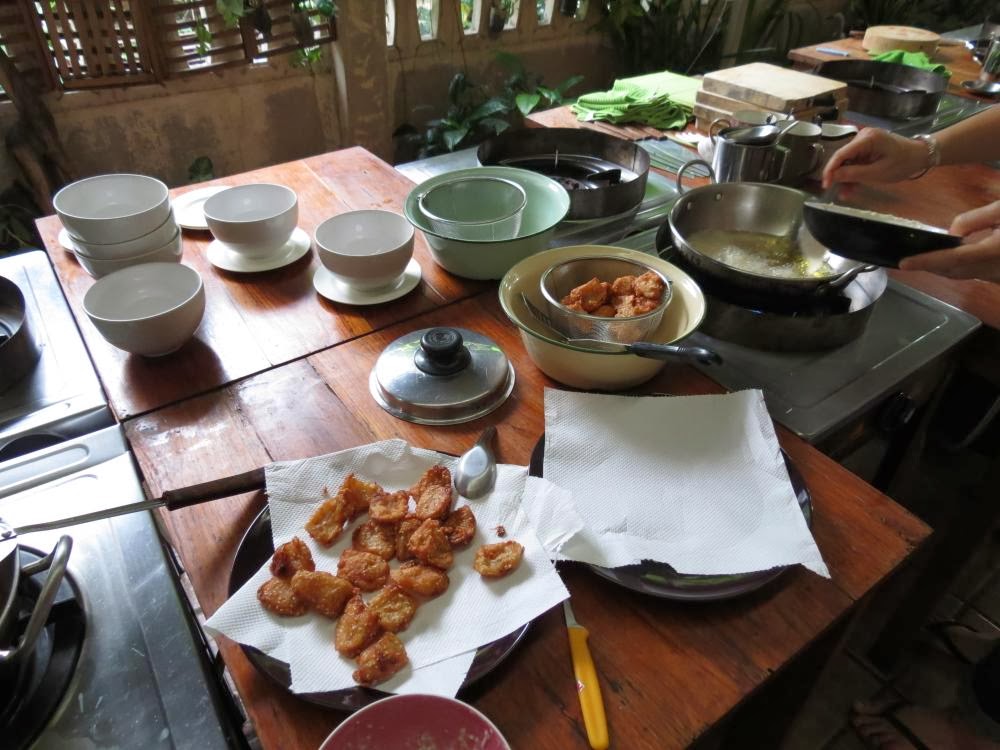
The tasty banana fritters. My batter was thicker so the fritters were more chewy. An important lesson was understanding how the quantities affect the result. For example I put less curry paste in so my curry was paler and less piquant. A good cook adapts.

Yui is an amazing lady and teacher with a great sense of humour and very sensible attitudes to food and life: Cook good food, eat healthy, and enjoy variety. She has appeared on cooking shows and taught in places as far flung as Brazil. Have a look at all the smiling faces in her gallery here.

Thursday, 14 November 2013

Elephant Nature Park

I woke up before dawn due to the jet lag. I couldn't get back to sleep so I washed up, dressed and walked to the Tha Phae gate. The streets had been swept clean, a contrast to the night before. I wondered why the city didn't provide more garbage bins. Maybe people would start dumping their household refuse there. At 0700 the only place serving was a fast food outlet where I had pancakes and coffee. When I got back to the hostel I saw that had I waited I could have had a healthy müsli breakfast cheaper. But the pick up time of 0815 didn't leave much time anyway.


I had arranged for a visit to ENP, an elephant refuge, for the day. I'm not really a fan of these beasts, they aren't sufficiently small, soft and cuddly for me, but they have their place in nature. I figured that since I was visiting Asian elephant territory, I might as well see them up close.

After picking up all the participants, we were transported to the park some 60 km outside Chiang Mai. Along the way they screened a couple of videos. One was about the cruel practice of using baby elephants as tourist attractions, and another was a profile of the park and its founder as well as footage of wild elephants.


We were day trippers, but other lengths of stay are available. Some people volunteer for longer periods at the park. The park gets more applications than they have accommodation for, so long stays are often booked out far ahead. These beasts must engender affection in people. We also saw a school group getting an educational experience.


Our guide explained the precautions we should take around elephants. Then it was morning feeding time. The elephants came to the platform to be fed watermelons, pumpkins and bananas. They scooped up the proffered food with their trunks and popped them into their mouths. As you can imagine, they have great appetites and most of the park fees goes towards food.


Naturally people found the babies cute.


All the fruit have to be purchased from farmers. This is the banana section of the larder.


And the watermelon section.

The video showed them being fed corn but our guide explained that corn is seasonal so not available this time of the year.


The guide is explaining how they concoct a mush ball containing medicine so that the elephant won't reject the medicine due to the bitter taste.

The Asian elephant is endangered due to poaching and habitat loss. In 1989, due to the alarming rate of deforestation, a total ban was placed on logging in Thailand. This was the right move for the forests and the wild elephants. But it had the side effect of putting many captive elephants out of work. Some of them ended up in the streets as tourist attractions. Elephants are sensitive to noise and vibrations, so it's very cruel to keep them in an urban area.


After this we moved to the skywalk where we could approach the elephants and pat them.

Notice the odd posture of this elephant. Medo's ankle was injured by a falling log when she was a logging elephant. Later she was inflicted more injury by a bull elephant in an attempt to use her to breed. Her backbone is permanently dislocated. ENP rescued her and now she can live out her days at the park.


Elephant enjoying a mud bath.

Many of the elephants at the park have appalling histories of abuse before being rescued. Some are blind, some have landmine injuries. Their stories make one ashamed of humans.


Elephant having a good scratch.

Lek, the founder of the park, is a diminutive Thai woman who has devoted her life to caring for these rescued beasts. She is a saint to these animals.


After a delicious vegetarian lunch (Thai are so good at cooking delicious food even in the absence of meat), it was time to bathe the animals. Elephants love this part, and happily stood in the water while the visitors splashed buckets of water over them.


I didn't participate because I had not come with a change of clothing as you get wet in this activity.

I couldn't help thinking Ikea Effect when watching my fellow day trippers at work. Those who have taken a psychology course will understand. Similar to the Tom Sawyer Effect.


After the elephant washing, more pictures were taken around the skywalk. The handler is feeding a cute baby.


Another feeding, for the afternoon. Then the guide took us on a walk around the grounds and pointed out the elephant who had gammy foot due to a landmine. Landmines are a hazard in the border areas of Thailand.

Elephant groups have social structure and the guide told us which elephants would associate or avoid.

And that was the end of the program for the day before being driven back to our lodgings. It wasn't the most scenic of days, but I'm glad I took the tour to learn more about these amazing animals. If there is one lesson to take away from the visit, it is never patronise street displays of elephants in Thailand.


I asked to be dropped off near the Tha Phae gate so that I could change money and have dinner before walking back to the hostel. At the market, I found a hole in the wall place with glowing testimonials by visitors from all over. The Pad See Ew was indeed fantastic. I had it with Moo (pork). Beef is not Oink, by the way, hahaha. For 50 baht (< $2) I got a portion about half the size of what one would get here but that was all the better for portion control. This was followed a gelato for 30 baht.

No Yi Peng lanterns tonight. Maybe people were saving their effort for the weekend.